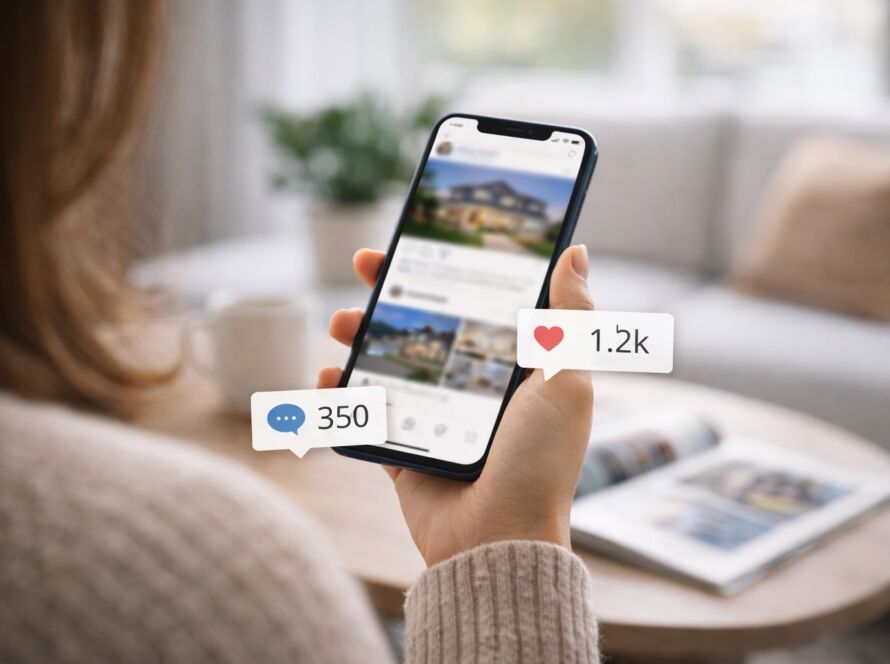
Real estate agent ads typically serve one purpose: the active listing. A campaign goes live when a property hits the market, runs through the transaction window, and stops when the listing closes. That creates immediate visibility for the property, which is exactly what a listing ad is designed to do.
But that approach builds almost nothing for your professional brand between closings. Real estate agents who run ads only around active listings disappear from their market’s awareness the moment a transaction wraps. The professionals who advertise strategically treat their campaigns as two separate investments: one that promotes active listings and one that builds the sustained recognition buyers and sellers associate with a trustworthy real estate agent.
Real estate agent ads work best when they accomplish both. The platforms you choose, the creative quality you maintain, and the consistency of your campaigns determine which of those goals you actually achieve.
The Two Jobs Agent Ads Do
A listing ad has a clear, immediate job. It introduces a property to buyers who match the target geography and price range, at the moment those buyers are actively looking. When the listing closes, the ad stops. This is a legitimate and measurable use of advertising. For any specific property, it is the right tool at the right time.
Brand ads operate on a different timeline. Their job is to make your name, your professional positioning, and your standard of care familiar to a local audience before those people are ready to hire a real estate agent. NAR’s annual Profile of Home Buyers and Sellers, the survey that documents homebuyer and seller activity each year, consistently finds that most buyers and sellers select their agent through a referral or prior working relationship, well before any advertising campaign enters the picture.
Running brand ads between transactions keeps your name in front of the people who will be in your market in the next six to eighteen months. Real estate agents who maintain that consistent presence build recognition that converts to inquiries without a cold start at the beginning of every new transaction cycle.
The practical implication: an ad budget that goes entirely to listing promotion leaves your pipeline dependent on the timing of active transactions. Allocating a portion of that budget to ongoing brand-presence campaigns creates continuity regardless of how many listings you are actively carrying.
Choosing the Right Platforms
Platforms are not interchangeable. Each reaches a different audience through a different mode of attention, and for real estate advertising, that distinction shapes your results more than budget size alone.
Facebook and Instagram are where most real estate agent ads run, and for good reason. These platforms offer the most precise geographic and demographic targeting in paid social. Real estate agents on Meta operate within the Special Ad Category for housing, which constrains certain demographic targeting options, but geographic, behavioral, and lookalike audiences remain available and effective. For residential listings and brand-building in the $300,000 to $2 million range, Facebook and Instagram represent the most cost-efficient paid social environment for most real estate professionals.
Google Search and Display capture active intent. A buyer searching for a real estate agent or browsing available homes is already in motion. Search campaigns reach that moment directly; display campaigns reinforce brand presence across Google’s publisher network. The combination works well in competitive markets where search visibility has measurable pipeline value.
Print and premium editorial command attention where algorithmic social cannot reach. Affluent buyers, particularly those purchasing at $2 million and above, research in contexts that carry editorial credibility: publications like Homes & Land, Robb Report, and Wall Street Journal Real Estate. Premium editorial placement through Homes & Land reaches audiences who respond to quality visual presentation and publication context rather than to social feeds.
For real estate agents building toward the luxury tier, the channel mix tilts toward premium media alongside social. For most residential real estate agents, Facebook and Instagram combined with selective Google campaigns cover the widest and most cost-efficient audience. Real estate ad campaigns designed for multiple channels perform best when anchored by consistent brand creative across all of them.
What Makes an Ad Worth Running
The platform matters less than the creative you run on it. A well-targeted campaign carrying weak, inconsistent, or visually generic ads builds little except the habit of spending budget.
Three principles govern the most effective real estate agent ads.
Visual quality signals professional standards. The photography in your ads communicates the same thing as the photography in your listings: your standard of care, your attention to presentation, your level of professionalism. Low-resolution or template-generic creative undercuts the brand message regardless of targeting precision. Editorial-quality images draw attention and hold it; generic creative scrolls past.
Consistency outperforms volume. A well-produced brand ad running consistently over six months builds more market recognition than a burst of varied campaigns across two weeks. Recognition is built through repetition under controlled visual conditions. Establish a visual identity (headshot, logo treatment, color palette, and format) and maintain it across every campaign. Sample real estate Facebook ads illustrate what brand-consistent creative looks like at the execution level.
One position, consistently held. Real estate agents who rotate messaging between neighborhood expert, luxury specialist, and price-reducer create confusion rather than recognition. Define what you want to be known for in your market and let every ad reinforce that position. Social media ads for realtors covers how to maintain that brand consistency across organic and paid social simultaneously.
For real estate agents who want AI-assisted social ad management built for the profession, Social AI Advantage applies machine-learning optimization to campaign targeting and creative rotation while keeping brand presentation consistent.
The Fair-Housing Framework for Real Estate Agent Ads
Real estate advertising on Meta platforms falls under the Special Ad Category for housing. This category exists to keep real estate advertising compliant with fair-housing law. Meta’s guidance for the Special Ad Category outlines the demographic targeting options restricted in housing ads, including age, gender, and ZIP-level geographic targeting, and clarifies which targeting methods remain fully available.
What remains available within this framework is substantial:
- Geographic targeting at the city, county, or radius level
- Lookalike audiences built from your existing client list, email contacts, or website visitors
- Behavioral and interest targeting around homebuying, home improvement, and real estate research
- Retargeting to people who have engaged with your content or visited your website
Real estate agents who understand the framework run effective campaigns within it. The Special Ad Category is not an obstacle to advertising; it is the operating environment. Accounts that advertise outside the category face suspension and fair-housing complaint exposure that is entirely avoidable.
Google Ads imposes fair-housing requirements on real estate advertising as well, with documented guidance on permitted targeting options for housing-related campaigns. Both platforms provide policy documentation, and the framework on both is workable once you understand the constraints.
Where Ads Fit in the Bigger Picture
The real estate agents who run the most effective advertising treat campaigns as one component of a coordinated system, not the whole system. A well-run Facebook campaign generates awareness and inquiry. What happens when that inquiry arrives determines whether the spend converts to a client. CRM discipline, follow-up cadence, and the content present across your digital channels all contribute to whether a real estate agent ad creates a client or just a click.
The same principle applies at the channel level. Social advertising, premium editorial placement, Google search, email, and video reach different audiences at different moments in the buying or selling process. Running them in coordination, with consistent brand presentation across all channels, produces better outcomes than optimizing any single channel in isolation. The recognition built in premium print carries forward when a buyer encounters your name in a social feed, and that cross-channel reinforcement is where luxury real estate advertising and digital campaigns support each other most effectively.
That coordination is what a full digital marketing system makes possible. The real estate digital marketing guide covers each channel, the sequencing logic that ties them together, and how to measure the system rather than individual campaigns.